Sunday, August 5, 2012

Time to Put My Money Where My Standards Are #Summerblog12 #SBG

#9 in the Summer 2012 Blogging Challenge, #Summerblog12

Traditional Gradebook


So, I've mentioned that I will be teaching sixth grade social studies this coming school year (Read about it here, here, and here). While I am still preparing to unveil the topics and structure of the class, I am ready to talk briefly about grading.


In the past, I mean the distant past, when I last taught seventh grade social studies, I used a pretty traditional point system for grading. Every assignment was worth points, and students could earn points by getting work in on time, by completing it at all, by following a scoring guide or rubric. Wrapped up in all this was the idea that the grade could show both learning and all sorts of habits (completion, participation, effort, etc.) While I made a big deal about everyone starting off with 100% to encourage a positive start, I took points off for late papers and gave zeros for missed assingments. I rationalized that I gave the students every opportunity to get a good grade.


Now, I've got to practice what I've been preaching since I've left the classroom (I wrote about grading here and here). First to go, the zero. Gone. Not going to give one. Next out is points for every assignment.


Here's how it will work, a new system that I just created. I will call it Standards Based Grading (Full disclosure: I did not create this at all). For this year, I will be using the Vermont Grade Expectations for 5/6 Social Studies and the Common Core State Standards for Reading in Social Studies. I will identify one or more of the standards for every assignment. Then, the PowerTeacher gradebook will allow me to assign a score for each standard used in that assignment. I will report much more about PowerTeacher grade book after I've used it for a while.


Some questions that I still have to answer.

  1. Should the term grade be based on an average of standards, the last assessment of that standard or the last three?
  2. What do I do about missing work (more about a school wide initiative later)?
  3. How will I account for compliance reporting (homework, participation, etc.)?
  4. What are the other pitfalls?
So, I plan to go whole hog into Standards Based Grading; putting my money where my mouth is.


Saturday, July 28, 2012

EdCamp Vermont Reflections #SummerBlog12 #VtEd

#8 in the Summer 2012 Blogging Challenge, #Summerblog12


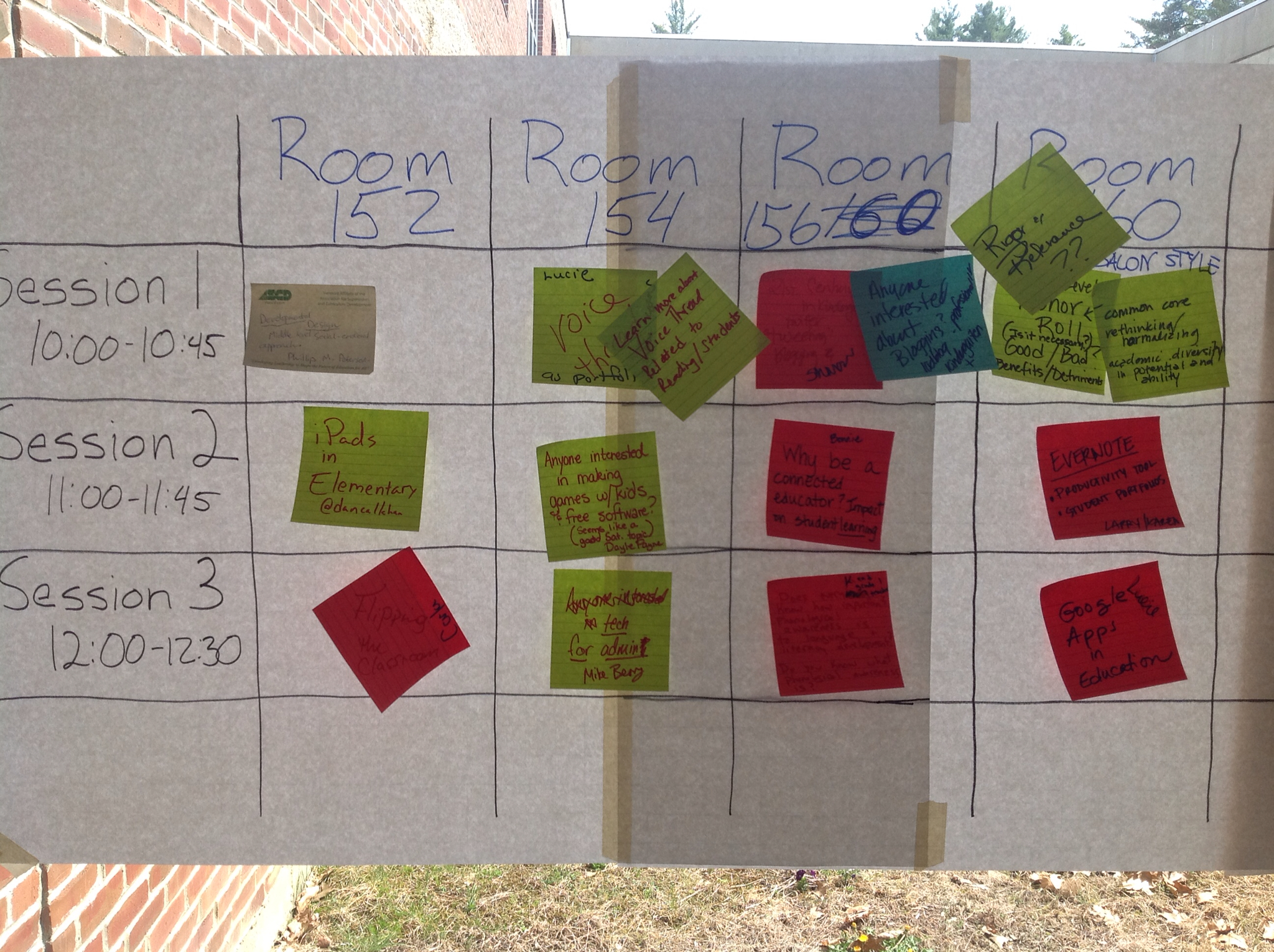
In April, 2012, I led the Vermont ASCD's first effort at an "unconference." EdCamp Vermont had its roots in another place and another time.

In the fall of 2010, I was driving to some EdCamp with Dan Callahan, when he brought up the idea of EdCamp Boston. He had come up with a date and a venue with some other folks and was ready to add to the organizing committee. I jumped at the chance. Through the winter, I did my part working with an amazing committee to put together the first EdCamp Boston in April 2011.

Shortly before EdCamp Boston, I accepted the position as principal of Wolcott Elementary School in Vermont. I was thrilled to have the position in place before EdCamp. When I told Dan that I got the job and would be moving to Vermont, the first thing he said was, "When is EdCamp Vermont?" I laughed him off figuring that in my first year in a new state there was no way I'd be able to organize an EdCamp.

As I settled into my new house and job, I was asked to join the newly reconstituted board of the Vermont ASCD. The new president, Ned Kirsch, had been a twitter contact for a while. I accepted.


At one of the first meetings, I mentioned EdCamp. Ned and the board were intrigued, and we decided to make Vermont's first EdCamp part of the VTASCD revival. I was thrilled. Organizing an EdCamp as part of an existing organization is super easy. We didn't have to set up a bank account or search for sponsors. We kept our plans small. You see, Vermont is very rural and spread out.


So, on a Saturday morning wedged between the vacation weeks of various parts of the state, about 40 educators showed up for a classic-style EdCamp. We had participants from all over the state, from as far as Boston, and even over the border from Canada. Even with a small crowd, we filled the session board and even added a fourth room. As usual with an EdCamp, the conversations were wonderful.


Now that we've held one EdCamp, VTASCD will surely hold another. Stay tuned for more information.


Sunday, July 15, 2012

The Tools I Use #Summerblog12

#7 in the Summer 2012 Blogging Challenge, #Summerblog12


Every once in a while, I read a post from my PLN about what tools they use to do their work. Recently, Dan Callahan did just that.

So, my work consists of principaling, blogging, and reading. For almost everything, I use my iPad 3. I think it might be the best computer I have ever owned. I primarily use the following software: Blogsy, Echofon for twitter, Reeder for rss feeds, Kindle for reading, Toodledoo for todos, Evernote for note taking and storage, and Notability for handwriting notes and marking up PDFs. I tie everything together mostly with Dropbox. In fact, one of the main ways that I have been able to rely on my iPad is that most of my primary software tools connect with either the cloud or a desktop version. With a few small exceptions, all my stuff is available on any platform.


Speaking of platform, I do use a three other tools besides the iPad. At home, I have a 2009, 15" MacBookPro. Still works great because I loaded it with extra ram when I bought it. Since I started using an iPad, I rarely pick up the MBP; in one fell swoop it became way too heavy.

At school, instead of having the district buy me a new laptop when I started, I decided to go big with a 27" iMac. This has been one of the best tech decisions I've made. The giant screen makes working with data a breeze. It's like having two monitors, but way cooler looking. The full computer is still necessary for intensive work, more complex spreadsheets, and a few websites here and there.

To round out my tool collection, I carry an iPhone 3G that works great on wifi. I only get cell coverage in certain places here in rural Vermont, but I still find the iPhone useful.

That's it for tools. I'll write more about how I use the iPad as a principal and how I plan to use it as a classroom teacher in a future blog post.

Thursday, July 12, 2012

Ancient Egypt to Medieval Florence in 80 Days #Summerblog12

#6 in the Summer 2012 Blogging Challenge, #Summerblog12


A vital part of riding a bicycle is knowing to where you are going. It stands to reason, then, that teaching (see this post for more info on my teaching) will be easier if I know the curriculum (duh!).

Over the past four years, my supervisory union has convened curriculum committees for literacy, math, science, art, music, and physical education. Notice that social studies is not on that list. That is until this spring. Since the committee is just getting started (more on that later), there is no district/SU Social Studies curriculum. Fortunately, one of the teachers in my building was able to find this chart for sixth grade social studies. Written years ago, this outline of the curriculum has only been loosely followed in recent years.

N.b. The standards referred to in the chart are from the Vermont History and Social Sciences GEs (Grade Expectations): Grades 5 – 6.

Please don't get me wrong, I like archaeology, Ancient Egypt, Greece & Rome, and the Middle Ages. The thing is, I'm not sure that these topics are the most important to teach my sixth graders. This is especially true when I think about how little understanding of the world the students have. Will studying early humans and ancient Egyptians really help the children of Wolcott as they prepare to go out in the world?

On the other hand, if I look at the topics only as vehicles to get the students to the enduring understandings and essential questions (or, in my case, the Grade Expectations), it doesn't really matter what topics I choose.

On the other, other hand, kids ought to learn about some of this stuff someday. If not now when? (Maybe high school?) There are really cool things to learn about in each of the topics. There are even some great connections to modern life, especially Greece, Rome, and Middle Ages (not so much with ancient Egypt, though).

So, I am still left with the question: What to teach?

Feel free to offer suggestions. I have an idea brewing that I will present in here soon.


Sunday, July 8, 2012

10 Top Ideas for Social Studies from the Kids #Summerblog12


#5 in the Summer 2012 Blogging Challenge, #Summerblog12


In a previous post, I mentioned that I would be teaching sixth grade social studies next year. Because we are in the midst of writing district social studies curriculum and there was little guidance in the past, the choice of topics is wide open. Of course, I expect to use the History and Social Sciences GEs (Grade Expectations): Grades 5 – 6, but there is far too much in this to do well in two years, let alone one year. The GEs are created in the style of thematic and understanding/doing standards. There is almost nothing in the GEs that suggests what specific topics should be taught, only specific social studies skills, processes, and connections. I like that style of standards much more than the Massachusetts standards that are only about content. As much as I might like the Vermont GEs, they don't tell me what to teach (or do they? More on this in the near future.)

Since I was encouraged by the fifth grade social studies and 5/6 Language Arts teacher to take a fresh look at what we teach (as long as she has time to gather literature to connect with the social studies), I am taking that fresh look. Since I have been preaching the merits of letting students have choices as a form of autonomy (see my post about Drive), I realized that I better put my money where my mouth is. I decided to go to the kids to see what they want to study in sixth grade.

A few days before the end of the school year, I went to speak with the fifth grade (remember at my small school that the fifth grade is a single class) about their sixth grade social studies curriculum. I asked them a simple question, designed to get a simple response. After a moment to think about what interested them, here are the answers I got with my comments in parentheses:

  • Rome (been part of sixth grade recently)

  • Middle Ages (been part of sixth grade recently)

  • Dark Ages (been part of sixth grade recently)

  • Native Americans (covered somewhat in fourth and fifth grades)

  • Greek mythology (been part of sixth grade recently)

  • The Pilgrims (covered in fifth grade)

  • African Americans (hmmm... Could be interesting)

  • 1980's (I resisted the urge to suspend the kid who thinks my childhood is as historical as the Dark Ages)

  • WWI

  • WWII (Wars are always neat to study)

Well, only some of what the kids mentioned is stuff that I like to teach (does that even matter?). How did the kids' interests line up with the old Wolcott Elementary School 6th Grade Social Studies Map? Hmmm...


What to teach? I needed to take a look at what the map called for and what the retiring teacher had been teaching. Stay tuned for more.